
In a hurry?
- Work out the type of barking first: alert, frustration, fear, boredom, attention or being left alone.
- Shouting usually makes barking worse. To your dog, you're barking too.
- Reduce what sets it off: block window views, manage the front door.
- Teach your dog what to do instead, such as going to its bed when the doorbell rings.
Alex can help with this: Dog behaviourist.
Want Alex to look at your dog?
Four quick questions. We reply Monday to Saturday, usually within the hour.
Thanks, .
We reply Monday to Saturday, usually within the hour, by email from hello@essexdogtrainer.co.uk.
Can't see our reply? Check your junk or spam folder, and mark it "not junk" so you get the rest of our emails.
What happens next:
- Alex asks what happens and when. A short video helps, but never set your dog up to react just to film it.
- He tells you where he'd start and what it costs.
- You agree a time, at your home or at the field.
If your dog has bitten, keep them behind a gate or on a lead until you’ve spoken.
Nothing by the next working day? Email hello@essexdogtrainer.co.uk.
Preview only: this copy of the site is not connected to the enquiry inbox, so nothing was sent.
The doorbell goes and your dog explodes. Or it barks at every dog through the window, every fox in the garden, or every time you sit down to watch TV. The neighbours have started to comment.
Barking is how dogs communicate, so you'll never stop it entirely, and you wouldn't want to. What you can change is how much your dog barks, and how quickly it stops. The key is working out why it's barking, because each reason has a different fix.
Why dogs bark
Alert barking. At the doorbell, people walking past, noises outside. Your dog is telling you something is happening.
Frustration barking. Your dog wants something it can't have: to get to another dog, to get out, to get the ball.
Fear barking. Barking to make something scary go away, often with the body leaning back, tail low or hackles up. On walks this is often reactivity.
Boredom. A dog without enough exercise or anything to do will find its own entertainment, and barking is easy.
Attention or demand barking. Your dog has learned that barking gets you to look, throw the ball, or share your dinner.
Barking when left alone. Often a sign of distress, part of separation anxiety.
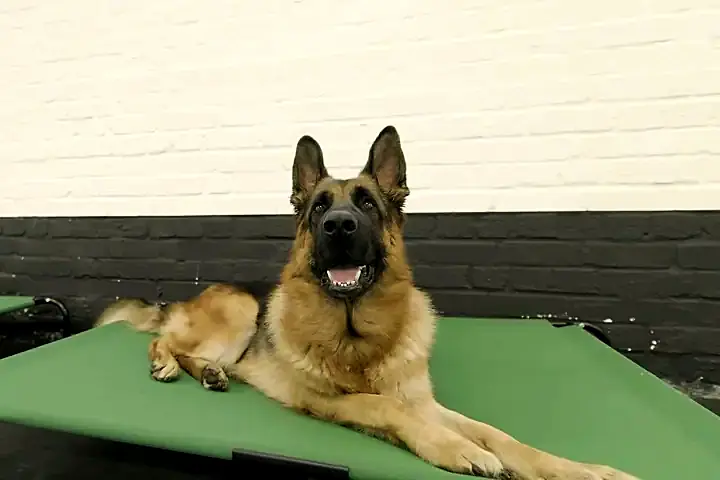
Barking at the door
This is the most common one. Make the doorbell predict something your dog can do instead:
- Teach your dog to go to its bed, with a reward, when you say a word.
- Practise with a helper ringing the bell or knocking, starting quietly, until your dog goes to its bed when it hears the bell.
- Use a lead or a baby gate at first so your dog can't rush the door.
- Let your dog bark once or twice, say thank you calmly, and send it to its bed.
Barking at things through the window or in the garden
Every time your dog barks at a passer-by and the passer-by walks on, your dog thinks the barking worked. Remove the practice: frosted window film or blinds on the low windows, no unsupervised time in the garden while you work on it, and interrupt and reward quiet when it does happen.
Barking at other dogs on walks
This is usually fear or frustration, and it's covered in my guide on reactive dogs on walks. The short version: increase the distance from other dogs until your dog can cope, reward calm looking, and slowly close the gap.
Attention and demand barking
Don't reward it, even with a telling-off. Turn away, wait for a moment of quiet, then give attention. It usually gets worse for a few days before it gets better, because your dog tries harder. Be consistent, and make sure your dog is getting enough exercise and things to do so it isn't simply bored.
- Shouting. It adds to the noise and often winds your dog up further.
- Bark collars. Electric shock collars are banned in England, and spray or sound collars only treat the noise, not the reason. A frightened dog that's punished for barking is still a frightened dog.
- Ignoring fear. If your dog is barking because it's scared, it needs help feeling safer, not just to be quiet.
If barking is causing problems with neighbours, is aimed at people or other dogs, or happens when your dog is left alone, it's worth getting help. I look at what's driving the barking first, then show you what to change. Behaviour help is £160 for your first 1.5-hour session at our field at Roxwell, west of Chelmsford, or £190 at your home, then £100 an hour at the field (£120 at home). Read about dog behaviour help in Essex.
Questions owners ask
Why does my dog bark at nothing?
It's usually something you can't hear or smell: a fox, a dog two gardens away, a noise from next door. Dogs' hearing is far better than ours. If it's new and happening at night, or with older dogs, get a vet check too.
Will my puppy grow out of barking?
Some puppies bark less as they settle, but barking that's rewarded tends to grow. Teach a calm alternative early, especially at the door.
Should I let my dog bark at all?
A couple of barks to tell you someone is at the door is fine for most owners. What you want is a dog that stops when you ask. Tell Alex about your dog using the form. Say when the barking happens and what sets it off, and he'll tell you what to do first.
Google review
“We first saw Alex last year in September with our 7 month old border collie. My partner and I had both been putting in a lot of work with our pup but didn’t feel as though we were making progress. …”
Read the full review
“We first saw Alex last year in September with our 7 month old border collie. My partner and I had both been putting in a lot of work with our pup but didn’t feel as though we were making progress. He was becoming possessive over resources, wouldn’t settle down and was in general proving to be very headstrong.
Alex has completely helped us to transform this situation by helping us to understand how to communicate and handle our dog. This approach has now allowed us to eliminate any form of possessiveness from his character and we understand how to help him fit into our lives.
We are now fully able to enjoy life with our dog and he is happily becoming the companion we wanted him to be.
There is still a lot of work to go but with Alex’s help I am confident for the future. I could not recommend him highly enough!”
Sources
Related
Last updated . This post is general advice, not a diagnosis. If your dog may be unwell or in pain, please see your vet.